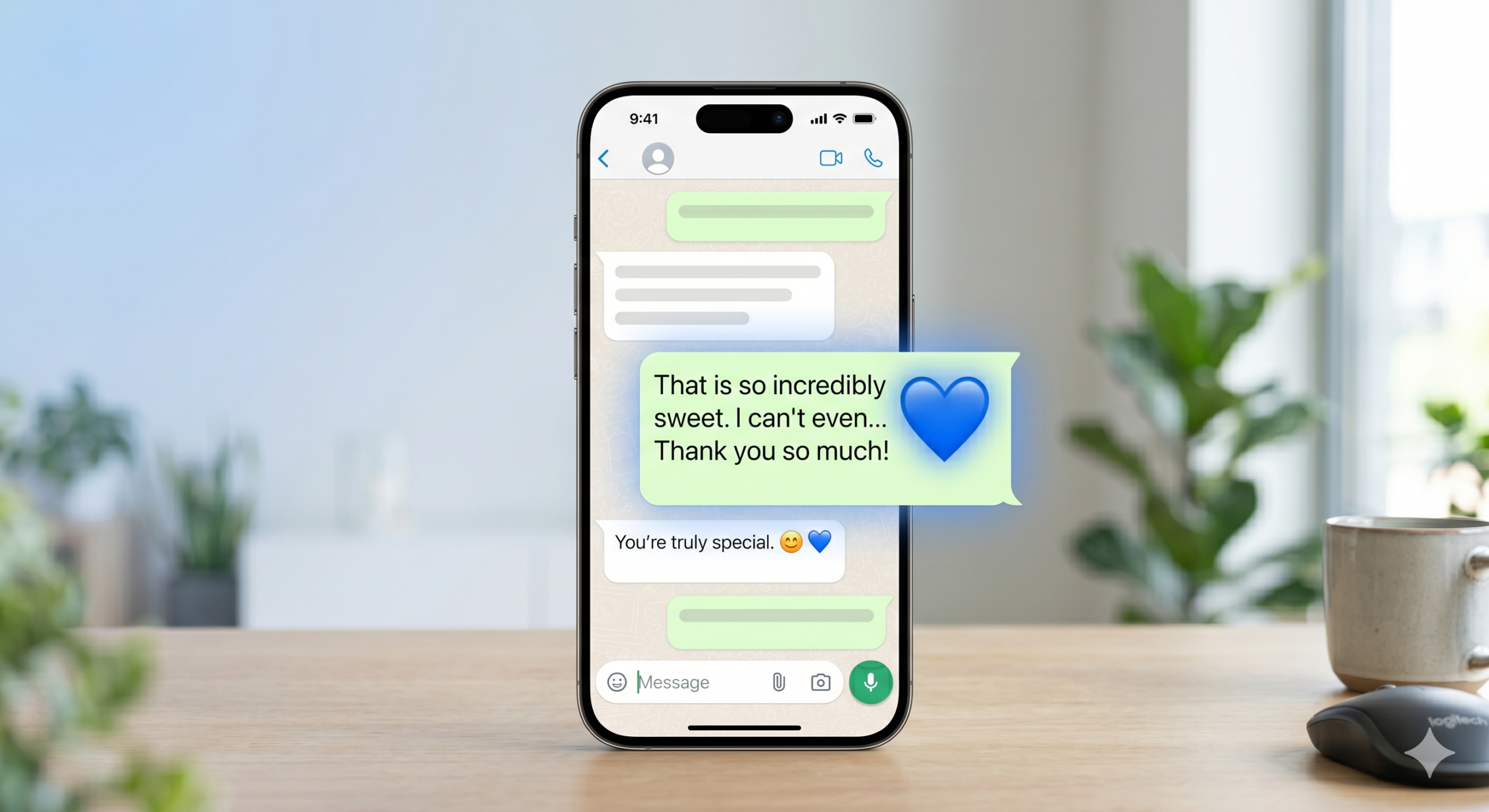
Aisha sent a long message about her grandmother passing away. She shared memories, told her WhatsApp contact how much it hurt, and waited. His reply came eight minutes later. It was one character: 💙.
She stared at it for five minutes. Then she called her sister. “Is this good? Is he brushing me off? Is this actually sweet or is it dismissive?” Her sister said “maybe he did not know what to say.” That felt like a non-answer. She spent the next hour reading everything she could find about what the blue heart means on WhatsApp. Nothing she found gave her a real answer. Most articles were three paragraphs of the same recycled paragraph about trust and loyalty.
What Aisha needed — and what you probably need right now — is not a dictionary definition. She needed to understand the emotional mechanics of how 💙 functions specifically inside WhatsApp, in a personal one-on-one conversation, from a real person who actually uses the app the way she does.
This guide gives you that. Every context. Every relationship type. Every signal the blue heart sends on WhatsApp — and what it does not send, which matters just as much.
WhatsApp users worldwide in 2025
Top 10 most sent hearts on WhatsApp globally
Distinct meanings depending on sender context
Year 💙 entered Unicode — used on WhatsApp since launch
What Does 💙 Mean on WhatsApp — The Direct Answer
The blue heart emoji 💙 on WhatsApp signals deep trust, steady loyalty, and genuine platonic or emotional care. It is not inherently romantic. It does not automatically mean friendzone. And it is not a cold emoji — despite the color suggesting otherwise to some people.
On WhatsApp, 💙 means deep and stable affection rooted in trust — typically platonic but not always. Sent alone after a vulnerable conversation, it means “I am here for you.” Sent in early dating when it replaces warmer emojis, it often signals emotional cooldown. Sent in a long-term relationship, it communicates security and calm love. Between close friends, it is pure loyalty with no romantic confusion. The relationship history between sender and receiver determines the actual meaning every single time.
Here is what makes WhatsApp different from other platforms. On Instagram, 💙 is often aesthetic. On Twitter, it signals solidarity with a cause. On Snapchat, it has a specific platform-assigned meaning tied to best friend status. But WhatsApp is primarily a personal messaging app. There are no likes, no public performance, no audience. Every 💙 sent on WhatsApp is directed at exactly one person — or one specific group. That intimacy changes everything about how you should read it.
For the full emotional and psychological background on what the blue heart represents as a symbol — before we get into the WhatsApp-specific layers — the blue heart emoji meaning in simple words guide covers the foundation clearly and in plain language.
Why WhatsApp Changes How 💙 Is Read
Platform context shapes emoji meaning more than most people appreciate. Consider that the same person might send 💙 on three platforms in the same hour — and mean something different each time.
| Platform | Audience | 💙 Most Common Meaning | Emotional Weight |
|---|---|---|---|
| Personal, private | Genuine care, loyalty, emotional support | High | |
| Semi-public, aesthetic | Visual identity, cause alignment, brand | Medium | |
| Snapchat | Close friends, platform-defined | Mutual #1 best friend (auto-assigned) | Platform-specific |
| Twitter / X | Public, broadcast | Solidarity, cause support, appreciation | Medium |
| TikTok | Public, aesthetic community | Trend identity, fandom, community belonging | Medium |
| iMessage / SMS | Personal, direct | Same as WhatsApp — fully context-dependent | High |
WhatsApp and iMessage sit at the top of the emotional weight column. There is no algorithm, no follower count, no performance layer. When someone opens a WhatsApp conversation and types 💙, they are making a deliberate, private, personal choice directed entirely at the recipient. That is why reading 💙 on WhatsApp without understanding the relationship context is like trying to read an expression without seeing the face it is on.
What 💙 Means From a Girl on WhatsApp
When a girl sends 💙 on WhatsApp, the message is almost always warm. But warm is a wide range. Here is how to actually read it.
If she sends it mid-conversation
She is expressing genuine appreciation or affection in real time. A 💙 dropped into the middle of a conversation — not at the end, not as a sign-off — means the emotion happened right there. Something you said landed. She is acknowledging it with the emoji that feels most honest to her in that moment.
If she sends it as a standalone message
This is the most emotionally loaded version. A single 💙 with no text around it, sent deliberately, means she felt something she did not have words for. It could be gratitude after you helped her through something. It could be affection that feels bigger than casual but smaller than romantic declaration. It is rarely nothing. A standalone 💙 from a girl on WhatsApp always deserves a real response — not just a 💙 back.
If it replaced a warmer emoji she was using before
Pay attention here. If your WhatsApp history with her shows consistent use of 🥰, ❤️, or 😘, and she has shifted to 💙 over the last few days, that shift communicates something her words have not said yet. It does not mean the conversation is over. It means the emotional temperature changed, and she is signaling it through the safest available channel — an emoji that cannot be directly confronted.
Six weeks of ❤️ exchanges, then four consecutive days of 💙
Lena and her boyfriend had been together for three months. Their WhatsApp exchanges were consistently warm — she regularly used ❤️ and 🥰. Then across four days in October, every message she sent ended with 💙. He noticed on day three. On day five, he asked directly if something had changed. She said she had been feeling uncertain about where things were going. She had not known how to bring it up. The 💙 was not a rejection. It was an emotional holding pattern — a signal that she was processing something she had not yet put into words. The conversation they had after he asked was the most honest they had shared. The emoji shift opened the door.
What 💙 Means From a Guy on WhatsApp
Men use 💙 on WhatsApp more than any other heart outside ❤️. That pattern is not random. It reflects something real about how many men express emotional depth in digital spaces.
Blue carries emotional weight without requiring visible vulnerability. A guy who would never type “I really care about you” in a WhatsApp message will send 💙 after a difficult conversation and mean exactly that. This is not emotional avoidance. It is a different emotional language that uses lower-risk channels to communicate high-stakes feelings.
In that exchange, the 💙 after “Always” is doing enormous emotional work. It converts a brief reply into a statement of commitment. A guy who sends that is not being minimal. He is being precise. The blue heart is the weight behind the word.
What 💙 Means From a Crush on WhatsApp
This is the question that brings most people to this guide. And it deserves a straight answer.
Receiving 💙 from a crush on WhatsApp is a positive signal — but not a romantic confirmation. Here is the honest breakdown.
The honest truth is this: 💙 from a crush on WhatsApp means they feel safe with you. It does not mean they are in love with you. But feeling safe is not nothing. It is often the foundation everything else builds on. Do not dismiss it. Also do not overread it into a declaration it was not meant to be.
What 💙 Means From a Best Friend on WhatsApp
Between genuine close friends, 💙 on WhatsApp is one of the clearest and purest emoji signals in digital communication. There is no ambiguity here. It means loyalty that does not need words. It means “I have got you and I will still have you tomorrow.”
Best friend exchanges of 💙 on WhatsApp tend to happen at specific moments. After one person helps the other through something hard. After a long conversation that went deeper than usual. After a silence that needed breaking with something warm but not heavy. The blue heart is exactly the right weight for all three.
One 💙 — after three hours on the phone at 2 AM
Rania had been on a WhatsApp voice call with her best friend for three hours. Her friend had received a difficult medical result. They talked, cried, made bad jokes at 1:30 AM the way close friends do, and eventually said goodnight. Twenty minutes after hanging up, Rania’s phone lit up. Her friend had sent one message: 💙. No words. Just that. Rania replied the same way: 💙. Neither of them explained it. Neither of them needed to. They both knew what it meant. That is what the blue heart does in real friendship — it holds the weight that language cannot carry without making it heavier.
What 💙 Means in a Romantic Relationship on WhatsApp
In an established romantic relationship on WhatsApp, 💙 functions very differently from how it reads in early dating. Here is the distinction that most guides completely skip.
In new relationships (under 3 months)
Early-stage romantic communication is still calibrating. Every emoji choice carries more signal weight because there is less context to absorb it. A 💙 in the first few weeks of dating can land as platonic — especially if the conversation has been leaning romantic. Use it thoughtfully. If you mean warmth and depth, pair it with words. The emoji alone in early dating leaves too much interpretive room.
In established relationships (6 months or more)
Here, 💙 often means something richer than the early stage allows. Long-term partners who send 💙 are usually communicating settled, deep, secure love. Not the hot urgency of new romance. The steady warmth of a relationship that has moved past needing to prove itself. Some couples use 💙 as their private shorthand for “I love you and I am not going anywhere.” That kind of meaning is beautiful when it is mutual and understood.
What 💙 Means in WhatsApp Group Chats
Group chat 💙 is a different creature entirely from personal message 💙. In a group, the performative element returns — even on WhatsApp, even in a small group of friends.
When 💙 Is Sent Alone — No Words, Just the Emoji
A standalone 💙 on WhatsApp — no text, no context, just the emoji sent by itself — is one of the most frequently misread signals in digital communication. People either overinterpret it or dismiss it entirely. Both are wrong.
- Sent after a long emotional conversation
- Sent at 2 AM when words feel like too much
- Sent by someone who rarely uses emojis at all
- Sent after you shared something vulnerable
- Sent as a check-in during a hard period in your life
- Sent by someone who has been quietly present for you
- Sent as a quick reply to a photo or meme
- Sent by someone who ends every message with a heart
- Sent in a group chat as a reaction to general news
- Sent as a conversation opener with no follow-up
- Sent as a WhatsApp reaction rather than a sent message
- Sent during a surface-level exchange with no depth
The key question to ask is not “what does 💙 mean?” in the abstract. It is “what does this person’s 💙 mean, given everything I know about how they communicate?” That is the real decoding work.
The Dangerous Shift: When 💙 Replaces ❤️ on WhatsApp
This section exists because it needs to. No other guide covers this clearly, and it is the context that causes the most confusion and pain.
When someone shifts from ❤️ to 💙 in an ongoing WhatsApp conversation — particularly in a romantic context — it is almost always a signal. Not necessarily a bad one. But always a meaningful one.
The shift can mean any of these things, depending on context. It can mean the relationship is settling into a deeper, calmer register and the sender is communicating security rather than passion. It can mean the sender is creating emotional distance and does not know how to say so in words. It can mean the sender’s feelings have shifted and they are testing whether you notice. It can mean nothing at all — they just saw someone else use 💙 and liked how it looked.
The problem is that you cannot know which of those it is without asking. And most people do not ask. They spiral into interpretation instead.
Eight months in, ❤️ became 💙. She panicked. He explained. Both were right.
After eight months together, Yusuf started signing off WhatsApp messages with 💙 instead of ❤️. His girlfriend Nadia noticed within two days. She said nothing for a week, then asked if something was wrong. He looked genuinely confused. For him, switching to 💙 was conscious — he had read something about how blue represents deeper, settled love and it resonated with exactly how he felt about where they were. For her, it had read as a temperature drop. They spent forty minutes on a WhatsApp voice note exchange talking about it. The outcome: they were fine. Better than fine. But the emoji created a week of unnecessary quiet anxiety. He now tells the story as a reminder that intention without communication is just noise.
How 💙 Compares to Other Heart Emojis on WhatsApp
Understanding 💙 on WhatsApp requires understanding the whole heart vocabulary — because the meaning of blue is partly defined by what it is not.
| Emoji | Heart | What It Signals on WhatsApp | Romantic Risk |
|---|---|---|---|
| ❤️ | Red | Deep romantic love, passion, primary commitment | High signal |
| 🧡 | Orange | Warmth, playfulness, comfortable friendship with energy | Medium |
| 💛 | Yellow | Happiness, casual affection, friendship and cheer | Low |
| 💚 | Green | Supportive care, wellness communities, sometimes envy | Very low |
| 💙 | Blue | Deep loyalty, trust, calm care — platonic or settled romantic | Context-dependent |
| 💜 | Purple | Admiration, spiritual connection, sometimes sensuality | Medium |
| 🖤 | Black | Deep bond, grief, dark humor, strong aesthetic identity | Context-dependent |
| 🤍 | White | Pure care, peace, mental health solidarity, minimalism | Low |
| 🩷 | Pink | Flirtation, early romance, playful and light affection | High signal |
For a detailed breakdown of how the orange heart operates in messaging contexts — it shares some of the warmth of red without the full romantic commitment — the orange heart emoji guide on HeartEmoji.pro covers the nuance clearly. And for the full weight of comparison at the other end of the spectrum, the red heart emoji guide explains why ❤️ carries a level of declaration that 💙 deliberately avoids.
How WhatsApp Renders 💙 — And Why It Looks Different
A detail most guides skip entirely: the 💙 your contact sees on their screen is probably not the same visual design as the one you see on yours. WhatsApp uses the operating system’s emoji font — not its own custom set.
| Device / OS | Emoji Font Used | 💙 Visual Style | Shade of Blue |
|---|---|---|---|
| iPhone (iOS 16+) | Apple Color Emoji | Glossy, rounded, 3D-style | Deep cobalt |
| Android (Pixel, stock) | Noto Color Emoji | Flat, clean, modern | Medium blue |
| Samsung Galaxy | Samsung One UI Emoji | Slightly rounded, Samsung-flavored | Brighter blue |
| WhatsApp Web (Chrome) | System + browser font | Varies by OS of the computer | Variable |
| WhatsApp Desktop (Windows) | Segoe UI Emoji | Flat, slightly geometric | Standard blue |
| WhatsApp Desktop (Mac) | Apple Color Emoji | Same as iPhone — glossy | Deep cobalt |
The underlying character is always Unicode U+1F499 — identical across every device. Only the visual rendering changes. For a side-by-side comparison of how 💙 looks across Apple, Google, Samsung, and other platforms, iEmoji’s blue heart reference page shows current renders for each major platform. And if you need a consistent image version of 💙 for design or branding work, favicon.io’s blue heart resource provides clean PNG versions at multiple sizes.
Mistakes People Make Reading 💙 on WhatsApp
After reviewing hundreds of real conversations and reader questions about blue heart meaning on WhatsApp, here are the recurring errors — and what to do instead.
She thought he sent 💙. He had actually just reacted to her message.
Maya texted her close male friend a long message about a career decision she was struggling with. Fifteen minutes later, she saw 💙 on her message. She spent the evening reading warmth and care into it. When they spoke the next day, she thanked him for the blue heart. He looked genuinely puzzled. He had reacted to her message as a quick acknowledgment — the WhatsApp equivalent of a nod — while in a meeting. He had not even processed the full content yet. Maya was not wrong to feel the warmth of the gesture. But she had built emotional meaning on what was functionally a one-tap reaction made in passing. The lesson: if a 💙 feels significant, confirm it with a conversation rather than a solo interpretation session.
One 💙 after a grief message — what it actually meant
Returning to Aisha from this guide’s opening: she eventually asked the person directly, three days later, what he had meant by the 💙. He said: “I did not have words. I did not want to say the wrong thing. I wanted you to know I was there without making it about me.” She had interpreted it as dismissal. It was the opposite. His 💙 was the most honest thing he could send in a moment where language felt inadequate. She told him that next time, even two words alongside the emoji would help. He agreed. The blue heart was right. The surrounding silence was the actual communication failure. Emoji do not replace words. They work with them.
Final Verdict on Blue Heart Meaning in WhatsApp
Conclusion
Every article about emoji meaning will tell you the blue heart represents trust and loyalty. That is true. But knowing the definition does not tell you what it means when a specific person sends it to you on WhatsApp at a specific moment in your specific relationship.
What this guide tried to give you is something more useful than a definition. It tried to give you a framework for reading the emoji in the only place it actually exists — inside a real conversation between real people who have history, context, and emotional stakes that no dictionary can capture.
The blue heart is honest. It does not pretend to be more romantic than it is. It does not diminish what it carries. It sits in the exact emotional register it belongs in — steady, deep, and present. If someone sent you 💙 on WhatsApp today and that is why you are here, know this: it almost always means something good. Read it carefully. Respond to it honestly. And if the meaning matters enough to wonder about, it probably matters enough to ask about.
For a deeper look at how 💙 compares to every other heart emoji across all contexts — not just WhatsApp — the HeartEmoji.pro complete emoji guide covers every color with the same depth this guide brought to blue on WhatsApp.
Frequently Asked Questions
What does the blue heart emoji mean on WhatsApp?
Does 💙 on WhatsApp mean friendzone?
What does it mean when a girl sends 💙 on WhatsApp?
What does it mean when a guy sends 💙 on WhatsApp?
Is it a bad sign if someone sends 💙 instead of ❤️ on WhatsApp?
What does 💙 mean in a WhatsApp group chat?
What is the difference between a 💙 WhatsApp reaction and a sent 💙 message?
Why does 💙 look different on my phone vs my contact’s phone in WhatsApp?
Can I use 💙 on WhatsApp in a professional or work context?
I sent 💙 and my crush did not respond. What does that mean?
Understand every heart emoji across every platform
Complete meaning guides for every heart color, context, and relationship type — all free, no account required.